
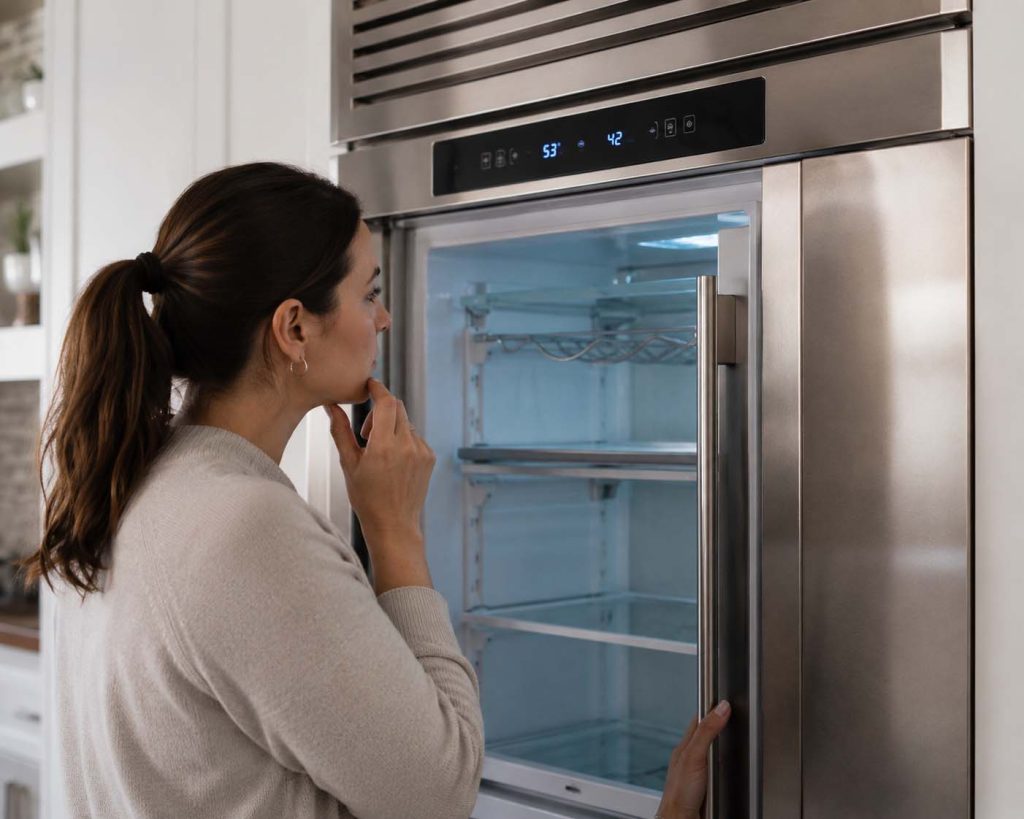
If your Viking refrigerator is not cooling, check the power, temperature settings, and door gaskets first, then clean the condenser coils behind the top grille and give the unit 24 hours to stabilize. If it still runs warm, a failed evaporator fan, defrost part, or compressor is the likely cause — call a technician.
Viking refrigerators — especially the 36- to 48-inch built-in models — cool with the same core parts as any fridge: a compressor, a condenser fan, an evaporator fan, and a defrost system. That means a short troubleshooting checklist finds most faults. 5 Star Appliance Repair is a family-owned company with more than 20 years in business and over 100,000 households served, repairing premium brands like Viking, Sub-Zero, and KitchenAid alongside everyday models. Below are the checks our technicians run first, and the warning signs that call for a professional refrigerator repair service.
Start with these five checks
Start Viking refrigerator troubleshooting at the wall, not inside the cabinet. Confirm the display panel is lit, the breaker has not tripped, and the unit is not in showroom or Sabbath mode — settings that keep the lights on while cooling is off.
Next, check the setpoints. The FDA recommends holding your refrigerator at or below 40°F and your freezer at 0°F for safe food storage. Set the fresh-food section to 37°F, which gives you margin on warm days.
Then test the door gaskets. Close the door on a dollar bill: if it slides out with no drag, the gasket is letting warm air in. Overpacked shelves matter too — food stacked against the rear vents blocks the cold-air supply.
After any change, give the unit 24 hours before judging the result. A refrigerator needs a full day to stabilize, which is why our technicians ask customers to keep it running before a diagnosis visit.
Why is my Viking refrigerator not getting cold?
The most common causes are dirty condenser coils, a failed evaporator or condenser fan, a worn door gasket, or a defrost fault that has buried the evaporator coil in frost. Compressor failure is the most serious cause, but also the least common. Work through the airflow problems first — they are the cheapest fixes.
How do you reset a Viking refrigerator?
Switch the unit off at the breaker or unplug it, wait 5 minutes, then restore power. This power cycle clears the control board and restarts the cooling cycle on most Viking models. A reset can clear a control glitch, but it will not fix dirty coils, a dead fan, or a weak compressor.
Clean the condenser coils — the most common fix
Dirty condenser coils are the most common reason a Viking refrigerator stops cooling. Viking’s built-in units place the compressor and condenser behind the top grille, where they pull in kitchen air, grease, and dust all day.
When the coils coat over, the sealed system cannot shed heat, and the unit runs warm no matter what the setpoint says. Our technicians recommend cleaning built-in condenser coils every 3 to 6 months, based on more than 20 years of repair visits.
It is usually a 15-minute job. Cut power, open the top grille, and clean the coils with a soft brush and a vacuum. If the fridge is still warm 24 hours after a coil cleaning, move on to the checks below.
Refrigerator not cooling but freezer works? Check the evaporator side
When the freezer holds 0°F but the fresh-food side climbs above 40°F, the evaporator fan or defrost system is the usual suspect. Most Viking models cool both compartments from one set of evaporator coils, with a fan pushing that cold air to the fridge side.
A failing evaporator fan is often loud before it dies — listen for buzzing or clicking behind the freezer’s back wall. The good news: an evaporator fan swap is usually a one-visit fix.
If the defrost heater or defrost thermostat fails, frost slowly buries the evaporator coil and chokes off airflow. Our short guide to a fridge that is warm while the freezer stays cold walks through a 2-minute check you can run yourself.
Viking refrigerator compressor and sealed-system problems
Compressor trouble shows up as rapid clicking, a unit that runs constantly without reaching temperature, or both compartments turning warm at once. On a built-in Viking, a top grille that feels unusually hot is another sign the sealed system is straining.
Replacing a refrigerator compressor costs $200 to $450 on average nationwide, according to Angi. Built-in units and OEM Viking parts often run above national averages, so get a written quote before any sealed-system work — we provide one on every job.
Refrigerant leaks cause similar symptoms and are not a DIY job, since federal rules require certified refrigerant handling. These faults call for professional Viking appliance repair with proper gauges and recovery equipment.
Should you repair or replace a Viking refrigerator?
For a built-in Viking, repair wins in almost every case. Angi puts the average refrigerator repair at $200 to $300 — a small fraction of what a new built-in unit costs before cabinetry and installation.
The math changes for a freestanding Viking near the end of its 15- to 20-year lifespan. If a sealed-system quote passes half the cost of a comparable new unit, replacement deserves a look.
We walk owners of other premium brands through the same decision — our guide to common Sub-Zero refrigerator problems covers a close cousin of this repair-or-replace question.
Frequently asked questions
What is the life expectancy of a Viking refrigerator?
A Viking refrigerator typically lasts 15 to 20 years when it gets regular maintenance. Coil cleaning every 3 to 6 months and quick attention to small faults protect the compressor, the part that usually decides a refrigerator’s lifespan. If your unit is under 15 years old, repair is almost always the better financial call.
How do you reset a refrigerator that is not cooling?
Reset a refrigerator by unplugging it or switching off its breaker, waiting 5 minutes, and restoring power. This clears the control board and restarts the compressor cycle. Give the unit 24 hours to pull down to temperature before judging the result. If it still cannot hold 40°F, the problem is mechanical, and a reset will not fix it.
How much does it cost to fix a refrigerator that is not cooling?
Refrigerator cooling repairs cost $200 to $300 on average nationwide, with a full range of $40 to $1,000, according to Angi. Built-in units like Viking often price above these averages because parts cost more and access takes longer. 5 Star Appliance Repair provides a written quote before any work and waives the service call fee when you proceed with the repair.
Get your Viking refrigerator cooling again
Most Viking cooling problems come down to airflow: dirty coils, a blocked vent, or a stalled fan. Run the checks above, give the unit 24 hours, and track the result with a fridge thermometer.
If the fresh-food section still cannot hold 40°F, book a diagnosis online or call (855) 731-4952. Same-day appointments are available Monday through Sunday, 7 a.m. to 7 p.m., and the service call fee is waived when you proceed with the repair. We service Viking refrigerators across our markets, including appliance repair in Brea and Chicago.