
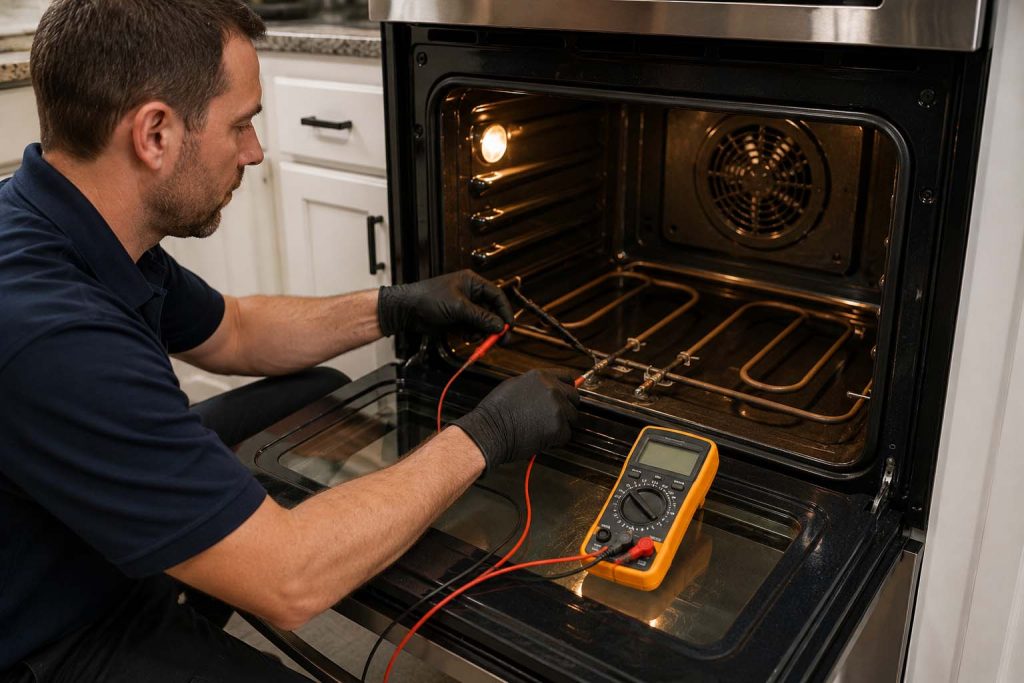
An oven that won’t heat usually comes down to one failed part: a worn igniter on a gas oven, a burned-out bake element on an electric oven, or a faulty temperature sensor or control board on either type. Check the power and your settings first, then diagnose the heating component. Most oven-heating repairs are a one-visit fix.
When your oven won’t heat, dinner stops and the guesswork starts. The good news: the fault is almost always a single, replaceable component, and a few of the causes you can rule out yourself in minutes. This guide walks through why an oven stops heating on both gas and electric models, the safe checks you can do at home, and the point where a certified technician should take over. 5 Star Appliance Repair is a multi-brand appliance repair company serving households across California, Illinois, Washington, and Washington, DC, and no-heat ovens are one of our most common calls. If you’d rather skip the diagnosis, professional oven repair is available same-day.
Start here: check the power and settings
Before blaming a part, rule out the two cheapest causes: no power and the wrong setting. An electric oven runs on a 240-volt circuit, and if it loses one of its two legs of power it can bake weakly or not at all while the clock and lights still work.
Run these quick checks in order:
- Confirm the oven isn’t in a delayed-start, Sabbath, demo, or timed-bake mode — a very common false alarm across Samsung, LG, GE, and Whirlpool models.
- Check the breaker. Reset any breaker that is tripped or sitting halfway; an electric oven needs a double-pole breaker fully on.
- Make sure a self-clean cycle isn’t still running or locked — the door stays latched and heat is blocked until it finishes.
- For a gas oven, confirm the gas supply valve is open and other burners light.
If power and settings are fine and the oven still won’t heat, the problem is a heating component. Which one depends on whether you have gas or electric.
Gas oven not heating: the igniter is the usual suspect
On a gas oven, a weak or dead igniter is the most common reason it won’t heat. The igniter has two jobs: it glows hot to light the gas, and it draws enough electrical current to open the safety valve. A tired igniter often still glows but never gets hot enough to open the valve within the roughly 90 seconds the system allows.
The tell is a glow that looks dull orange instead of bright yellow-white, or a burner that clicks and glows but never catches. Here’s how to check it:
- Turn the oven to bake and watch the igniter through the bottom vent (remove the oven floor panel if needed).
- If it glows more than 90 seconds without the gas lighting, the igniter is weak and should be replaced.
- If it doesn’t glow at all, the igniter, the wiring, or the control could be at fault — that needs a meter to confirm.
Safety first: If you smell gas, do not test anything. Turn off the gas supply, leave the door open, avoid switches and flames, and call your gas utility. Gas-valve and igniter work sits at the edge of safe DIY — when in doubt, book same-day service instead.
Electric oven not heating: inspect the bake element
On an electric oven, the bake element is the curved metal rod along the bottom, and a burned-out element is the top cause of no heat. Unlike most faults, this one is often visible: a failed element usually shows a blister, a break, or a bright scorch mark where it burned through.
To check it safely:
- Turn the oven off and let it cool completely, then set the bake mode and watch the bottom element.
- A healthy element glows an even bright orange across its whole length within a couple of minutes.
- If it stays dark, glows only in spots, or shows a visible break, it needs replacement.
- The broil element at the top can fail the same way — check it if only your broil function is dead.
A bake element is one of the more DIY-friendly oven parts, since it usually unscrews from two terminals at the back of the cavity. Still, the terminals carry 240 volts, so the circuit must be off at the breaker before you touch anything. A burned element is the same failure mode that stops a dryer from heating — you can read more in our guide on a dryer not heating.
Oven heats, but not to the right temperature
If your oven heats but runs cold, hot, or wildly uneven, the temperature sensor is the likely cause. This thin metal probe near the back wall tells the control board how hot the cavity is, and a drifting sensor makes the oven shut the heat off too early or too late.
A sensor reads about 1,080 to 1,100 ohms of resistance at room temperature; a reading far outside that range means it’s failed. A quick field check: if the probe is touching the oven wall, move it so it hangs free, since contact throws off the reading. If food is consistently undercooked and the oven seems 25 to 50 degrees off, the sensor is the first thing a technician tests.
When it’s the control board or a safety fuse
If the igniter, element, and sensor all test fine, the fault moves upstream to the control board or a thermal fuse. The electronic control board sends power to the heating components, and when its relays fail the oven gets no heat command even though everything downstream is healthy.
A thermal fuse is a one-time safety device that cuts power if the oven overheats — often after a self-clean cycle, which is the single most common trigger for a blown fuse or fried board. A tripped fuse doesn’t reset; it must be replaced, and the reason it blew should be found first. These parts need a multimeter and wiring diagram to diagnose correctly, so this is the stage where most homeowners call a pro.
Oven repair cost and when to call a professional
Most oven no-heat repairs are affordable and done in one visit, because they replace a single part. The table below shows typical U.S. ranges to set expectations — your local quote depends on the brand, part, and labor.
| Failed part | Typical repaired-by-pro range* | Fix time |
| Gas oven igniter | $150–$300 | One visit |
| Electric bake/broil element | $150–$300 | One visit |
| Temperature sensor | $120–$250 | One visit |
| Control board | $300–$600 | One visit, part depending |
*National benchmark ranges for context only — not a quote. Confirm current pricing with your local team.
Call a professional when the fault involves gas, the control board, or any test that needs a multimeter — and whenever you smell gas or see scorching. With more than 20 years in business and certified technicians offering same-day service, 5 Star diagnoses the exact failed part instead of replacing on guesswork. Browse all appliance repair services or read more troubleshooting guides.
Frequently asked questions
Why is my oven not heating up but the burners work?
Your oven not heating while the stovetop burners work points to the oven’s own heating circuit, not the gas or power supply. On a gas range it’s usually the oven igniter; on an electric range it’s the bake element or control board. The cooktop and oven use separate components, so one can fail while the other works fine.
Can I fix an oven that won’t heat myself?
You can safely handle the basics: resetting the breaker, canceling a wrong mode, or swapping a visibly burned electric bake element with the power off. Leave gas igniters, control boards, and anything needing a multimeter to a technician. If you smell gas, stop and call your utility and a pro immediately.
How long does an oven take to heat up normally?
A normal oven reaches 350°F in about 10 to 15 minutes. If yours takes far longer, never reaches the set temperature, or heats unevenly, a weak igniter, a partly failed element, or a drifting temperature sensor is the likely cause and worth diagnosing.
Is it worth repairing an oven or should I replace it?
Repairing an oven is usually worth it when the fix costs less than half the price of a comparable new unit and the appliance is under about 15 years old. A single igniter, element, or sensor is almost always worth fixing. A failed control board on an older oven is the point where replacement starts to make sense.
Why did my oven stop heating after the self-clean cycle?
Self-clean cycles run extremely hot and are the most common trigger for a blown thermal fuse or a damaged control board. If your oven quit right after cleaning, a safety fuse likely cut the power. It won’t reset on its own and needs replacement, so this one calls for a technician.
Getting your oven back to temperature
An oven that won’t heat is almost always one failed part — an igniter, an element, a sensor, or a board — and most are a one-visit fix. Start with the free checks: power, breaker, and settings. Then match the symptom to the component using the steps above, and hand off anything involving gas or the control board to a pro. To get an exact diagnosis and same-day repair for any major brand, book a service call with 5 Star Appliance Repair and get your oven back to temperature.