
You open the fridge and everything feels room temperature. You check the freezer and it’s perfectly fine — ice solid, everything frozen. So what’s going on?
Here’s the thing: this exact combination — warm fridge, cold freezer — is one of the most common fridge complaints we see. And the majority of the time, it comes down to one simple issue you can check and often fix yourself right now, without touching a single tool.
Give us two minutes. Here’s what to do.
First, Understand Why This Happens
Most modern fridges — fridge-freezers specifically — don’t actually have two separate cooling systems. They have one evaporator coil, usually located in the freezer section, and a small motorised damper (also called an air diffuser or baffle) that controls how much of that cold air gets pushed through into the fridge compartment above or beside it.
When the fridge is warm but the freezer is cold, it almost always means one of two things:
- Cold air is being produced just fine in the freezer — but it’s not getting through to the fridge
- The evaporator coil has frosted over and is blocking airflow entirely
Both of these are diagnosable in minutes. Start here.
The 2-Minute Check: Your Damper Control
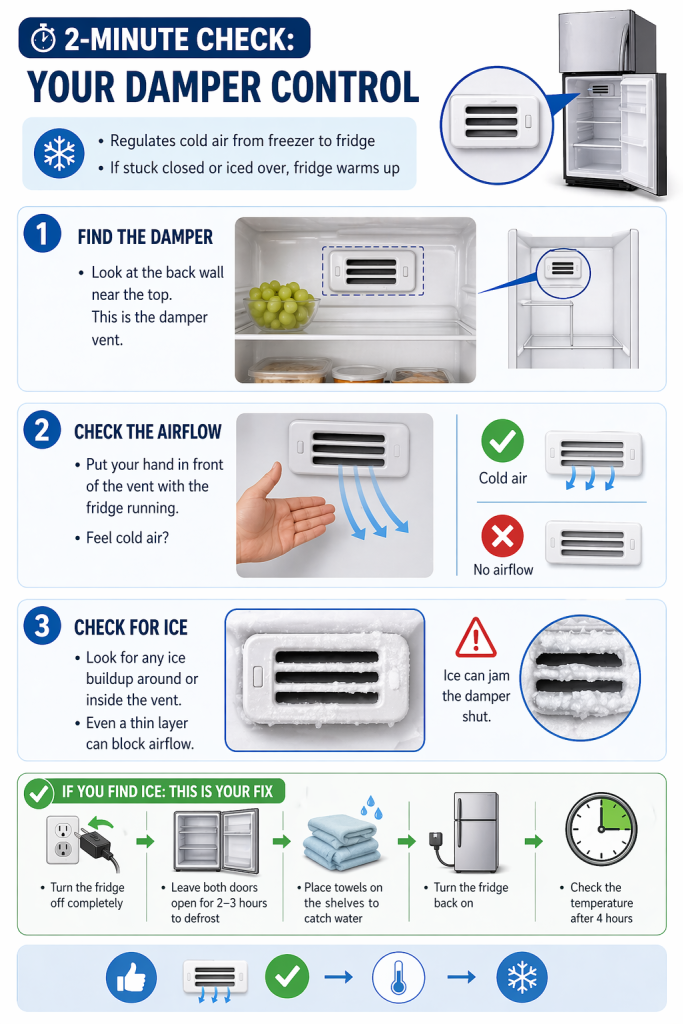
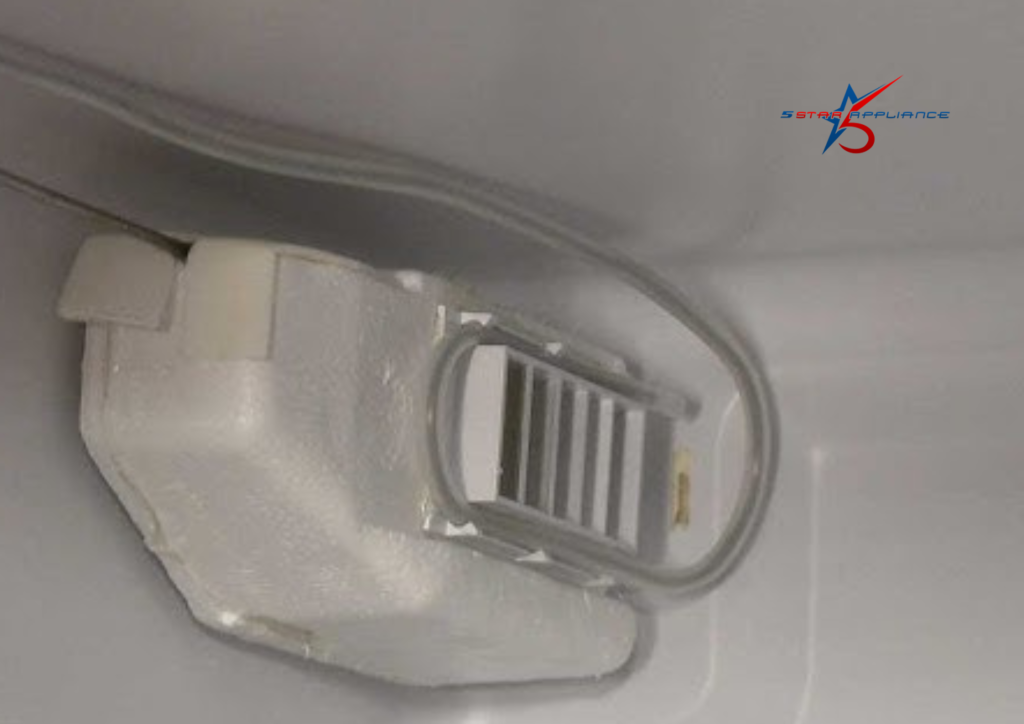
The damper is a small flap or valve — usually plastic — that sits between the freezer and fridge sections. It opens and closes automatically to regulate temperature in the fridge. When it gets stuck closed, jammed with ice, or fails mechanically, the freezer stays cold while the fridge gradually warms up.
Here’s how to check it right now:
Step 1: Empty the top shelf of your fridge and look at the back wall near the top. On most fridge-freezers there’s a small plastic vent or grille — that’s where the cold air enters from the freezer section. This is the damper housing.
Step 2: Put your hand in front of it with the fridge running. Can you feel any cold air coming through? If you feel nothing — no airflow at all — the damper is either stuck closed or iced over.
Step 3: Look closely at the vent. Can you see any ice buildup around it or inside the grille? Even a thin layer of ice is enough to jam the damper flap shut and completely block airflow into the fridge.
If you find ice around the damper: This is your fix. Turn the fridge off completely and leave both doors open for 2–3 hours to allow everything to defrost naturally. Place towels on the shelves to catch the water. Once fully defrosted, turn the fridge back on and check the temperature after 4 hours. In a large number of cases this is all it takes.
Why Does the Damper Ice Up?
The damper ices over when the fridge’s automatic defrost system isn’t doing its job. Every fridge has a defrost cycle that runs periodically — usually once or twice a day — to melt any frost that builds up on the evaporator coil. When this cycle fails, frost accumulates steadily until it blocks airflow completely.
The defrost system has three main components that can fail: the defrost timer, the defrost heater, and the defrost thermostat. Any one of them failing will eventually lead to exactly the symptoms you’re experiencing — freezer cold, fridge warm.
The manual defrost trick above will restore cooling temporarily. But if the defrost system component isn’t replaced, the frost will build back up within a few days or weeks and the problem will return.
Other Things to Check While You're At It
While you’re investigating, take 60 seconds to check these two things — they’re free fixes that solve the problem more often than you’d expect.
Are the fridge vents blocked by food? The internal vents that circulate cold air around the fridge compartment can be blocked by food containers, packaging, or overfilling. If items are pushed right against the back wall or stacked too tightly, cold air can’t circulate. Rearrange the contents to leave a couple of inches clear around the back and sides.
Is the fridge door sealing properly? A worn or damaged door seal lets warm air in constantly, making it impossible for the fridge to maintain temperature even if the cooling system is working perfectly. Close the door on a piece of paper. If you can pull the paper out easily with no resistance, the seal needs replacing. Check all the way around the door.
What If Defrosting Doesn't Fix It?
If you’ve defrosted the fridge fully and the problem returns within a week, or if there was no ice buildup at the damper to begin with, the issue is more likely a failed component rather than a frost blockage. The most common culprits at this point are:
Failed damper control: The damper motor or the thermostat that controls it has failed, leaving it stuck in the closed position permanently. The damper assembly is a relatively inexpensive part (£15–£50) and a straightforward replacement on most models.
Defrost heater or thermostat failure: As mentioned above, these components are what keep frost from accumulating. A multimeter test will confirm whether they’re working. Replacement parts are typically £10–£40 each.
Evaporator fan failure: The small fan that pushes cold air from the evaporator coil through the damper and into the fridge section may have failed. If the freezer is cold but there’s no airflow into the fridge and no ice blockage, listen carefully with the freezer door open — you should hear a fan running. No fan noise points directly to this component.
Defrost timer failure: On older models with a mechanical defrost timer, the timer can stick in the defrost position or fail to advance, meaning the defrost heater never switches off — or never switches on. A simple manual advance of the timer (using a screwdriver on the timer dial) can confirm whether this is the issue.
Should You Repair or Replace?
This is the question everyone asks, and the honest answer depends on the age of the fridge. If the appliance is under 8 years old, repair almost always makes financial sense — the parts involved are inexpensive and the labour is minimal. If it’s over 10–12 years old and you’re looking at a compressor issue or multiple failed components, a replacement may be more cost-effective in the long run.
A good rule of thumb: if the repair cost is less than half the price of a comparable new appliance, repair it. If it’s more than half, get a quote on replacement.
Fridge Still Warm After the Check?
You’ve tried the quick fix and something still isn’t right. That’s exactly what we’re here for. Our appliance technicians diagnose fridge-freezer problems every single day — and because we carry the most common parts on the van, most repairs are completed in one visit.
When you book with us:
- Same-day and next-day appointments available
- Accurate diagnosis before any work starts
- Upfront fixed pricing — no surprises
- All parts and labour guaranteed for 12 months
- We’ll always tell you honestly if replacement makes more sense than repair
Your food shouldn’t be at risk while you wait. Call us now.